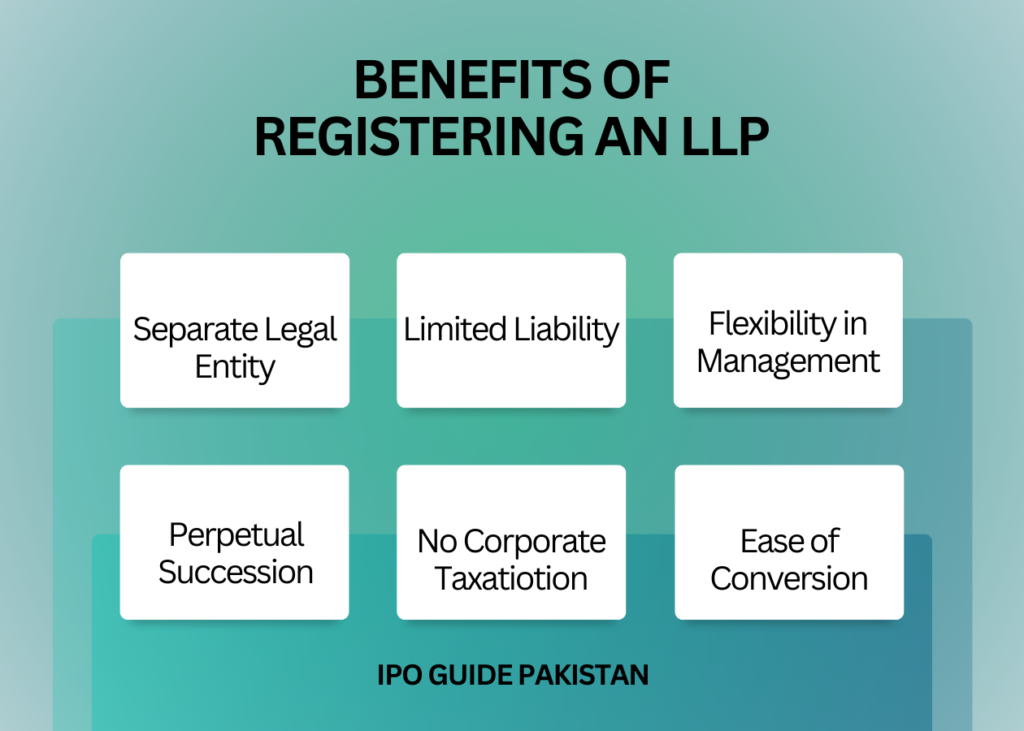
A Limited Liability Partnership (LLP) is a business structure that combines partnership-style flexibility with limited liability protection. Under the LLP framework, the entity is separate from its partners and can own assets, enter contracts, and sue or be sued in its own name.
Separate legal entity
Limited liability
Flexible management
Partner agreement
Business continuity
LLP Act 2017 in Pakistan
LLPs in Pakistan are governed by the Limited Liability Partnership Act, 2017. This legislation provides the legal foundation for:
Formation — Establishment and registration procedures
Operation — How LLPs conduct business activities
Partner responsibilities — Rights, duties and obligations
Compliance — Ongoing regulatory requirements
Dissolution — Winding up procedures where applicable
Key Features of an LLP
Separate Legal Entity
An LLP has a legal identity separate from its partners, enabling it to own property and enter contracts independently.
Limited Liability
Partners generally have liability limited according to their contribution, subject to exceptions such as misconduct or fraud.
Flexible Management
Partners can define management responsibilities and profit-sharing through the LLP agreement.
Perpetual Succession
The LLP can continue its existence despite changes, admission or exit of partners.
Business Credibility
Registration provides a formal business structure that can enhance trust with clients and institutions.
Flexible Profit Sharing
Partners can establish their agreed arrangement through the LLP agreement rather than fixed rules.
Is an LLP Suitable for Your Business?
An LLP structure may be worth considering for:
Startups and technology businesses
Agencies and professional firms
Consulting businesses
Family businesses
Service businesses
Businesses with multiple partners
The right structure depends on your specific circumstances regarding liability, taxation, management preferences and compliance capacity.
How to Register an LLP in Pakistan
Step 1 — Choose an LLP Name
The proposed name should comply with applicable SECP requirements and be distinguishable from existing registered names.
Step 2 — Name Reservation
Submit the proposed name through the applicable SECP process for review and reservation.
Step 3 — Prepare LLP Agreement
Draft an agreement covering partner rights, responsibilities, contributions, profit-sharing, management, decision-making, admission/exit of partners and dispute resolution.
Step 4 — Prepare Required Documents
Collect partner information, registered-office details and all prescribed documents/forms.
Step 5 — File With SECP
Submit the required application and documents through the applicable SECP registration process.
Step 6 — SECP Review
The application and documents are reviewed by the relevant authority for completeness and compliance.
Step 7 — Certificate of Incorporation
Once approved, the LLP receives its certificate of incorporation, confirming its legal existence.
Step 8 — NTN / Tax Registration
Complete relevant tax registration and compliance requirements after incorporation.
Step 9 — Other Licences
Depending on business activity, additional registrations or sector-specific licences may be required.
Documents Required for LLP Registration in Pakistan
Name reservation information or certificate where applicable
LLP agreement duly prepared and executed
CNIC copies of all partners
Registered-office address and proof
Prescribed SECP forms
Other documents as may be required depending on circumstances
Note: Exact documentation can vary depending on the application and circumstances. It is advisable to verify current requirements with SECP or a qualified professional.
Benefits of Registering an LLP in Pakistan
Limited Liability Protection
Partners’ personal assets are generally protected from business liabilities.
Separate Legal Entity
The LLP exists independently of its partners with its own legal identity.
Flexible Management
Internal structure and roles can be customised through the LLP agreement.
Business Continuity
The LLP continues despite changes in partnership composition.
Flexible Profit Sharing
Profit distribution can be arranged as agreed between partners.
Enhanced Business Credibility
Formal registration builds trust with clients, banks and authorities.
Why Is the LLP Agreement Important?
The LLP agreement establishes the practical relationship between partners and governs how the LLP operates. A well-drafted agreement can help reduce future disputes by clearly addressing:
Capital Contributions
What each partner contributes
Profit Sharing
Ownership and distribution arrangements
Roles & Responsibilities
Who does what in the LLP
Decision-Making
How major decisions are made
Admission & Removal
Process for adding or removing partners
Dispute Resolution
How conflicts are resolved
Exit Arrangements
Procedures for partner retirement, resignation or dissolution scenarios
What Happens After LLP Registration?
After receiving your LLP certificate of incorporation, ongoing responsibilities include:
SECP Compliance
Filing annual returns and maintaining statutory records where applicable.
Tax Compliance
Filing tax returns and maintaining NTN registration with FBR.
Financial Records
Maintaining proper books of accounts and financial statements.
Registered Office
Keeping registered-office information current with SECP.
Partner Information
Updating SECP when partner details change.
Sector-Specific Licences
Obtaining and renewing any additional permits required for your business activity.
LLP vs Traditional Partnership
Feature
LLP
Traditional Partnership
Liability
Generally limited
Generally broader/unlimited
Legal identity
Separate legal entity
Different legal structure
Management
Flexible
Flexible
Agreement
LLP Agreement
Partnership Deed
Registration authority
SECP
Relevant partnership registration authority
Common LLP Registration Mistakes
1
Choosing a Problematic Name
Names that are too similar to existing entities or violate SECP guidelines cause delays.
2
Incomplete LLP Agreement
Vague or missing terms create disputes later. Cover all key areas properly.
3
Incorrect Partner Information
Errors in CNIC details or partner data lead to application rejection.
4
Incomplete Documentation
Missing forms or proofs delay the registration process significantly.
5
Ignoring Tax Registration
Failing to obtain NTN after incorporation creates compliance issues.
6
Failing to Maintain Compliance
Neglecting annual filings and record-keeping risks penalties.
Frequently Asked Questions
What is an LLP in Pakistan?
A Limited Liability Partnership (LLP) is a business structure that combines the flexibility of a partnership with limited liability protection. It is a separate legal entity from its partners, governed by the Limited Liability Partnership Act, 2017.
How many partners are required to form an LLP?
At least two partners are required to form an LLP in Pakistan. There is no maximum limit on the number of partners.
Can a foreign national become an LLP partner?
Yes, foreign nationals can become partners in a Pakistani LLP, subject to applicable regulatory requirements and any sector-specific restrictions.
Is an LLP a separate legal entity?
Yes, an LLP is a separate legal entity distinct from its partners. It can own assets, enter contracts, and initiate or defend legal proceedings in its own name.
What documents are required for LLP registration?
Key documents include the name reservation certificate, LLP agreement, CNIC copies of partners, registered-office proof, and prescribed SECP forms. Additional documents may be required depending on circumstances.
Does an LLP need an LLP agreement?
Yes, an LLP agreement is essential. It defines partner rights, responsibilities, profit-sharing, management structure, and procedures for dispute resolution and partner changes.
Does an LLP need an NTN?
Yes, after incorporation, an LLP must obtain a National Tax Number (NTN) from the FBR and comply with applicable tax filing requirements.
What are the ongoing compliance requirements for an LLP?
Ongoing compliance includes SECP filings where applicable, maintaining financial records, tax compliance with FBR, keeping partner and registered-office information updated, and renewing any sector-specific licences.
Need Help Registering an LLP?
Choosing the right structure, preparing the LLP agreement and completing the SECP registration process correctly can help avoid unnecessary delays and compliance problems.
Disclaimer: This article provides general information about LLP registration in Pakistan and is not a substitute for case-specific legal, tax or regulatory advice. Laws, forms, fees, procedures and compliance requirements may change. Specific LLP matters should be assessed according to the applicable law and current SECP/FBR requirements.