


In the competitive commercial landscape of Pakistan, a trademark is more than just a logo or a name—it is the embodiment of a business’s goodwill and reputation. As Pakistan continues to integrate into the global economy, including accession to the Madrid Protocol, understanding the nuances of its intellectual property (IP) system has become critical for businesses.
While Pakistan operates under a “first-to-use” common law system, the statutory protections afforded by registration under the Trade Marks Ordinance, 2001 offer the strongest defense against infringement. Notably, Pakistan does not accept multi-class applications, requiring a separate filing for each class of goods or services.
The Scope of Registrable Marks
Pakistan has a broad definition of what constitutes a trademark. According to the law, a mark may include a device, brand, label, ticket, name (including personal names), signatures, slogans, words, letters, numerals, or figurative elements.
Beyond traditional marks, Pakistani law theoretically allows for the registration of non-traditional marks such as colors, sounds, and three-dimensional designs. However, smells remain ambiguous due to difficulties in graphical representation. To be registrable, a mark must be capable of graphical representation and possess a distinctive character, serving to distinguish the goods or services of one undertaking from another.
Key Steps and Requirements for Registration
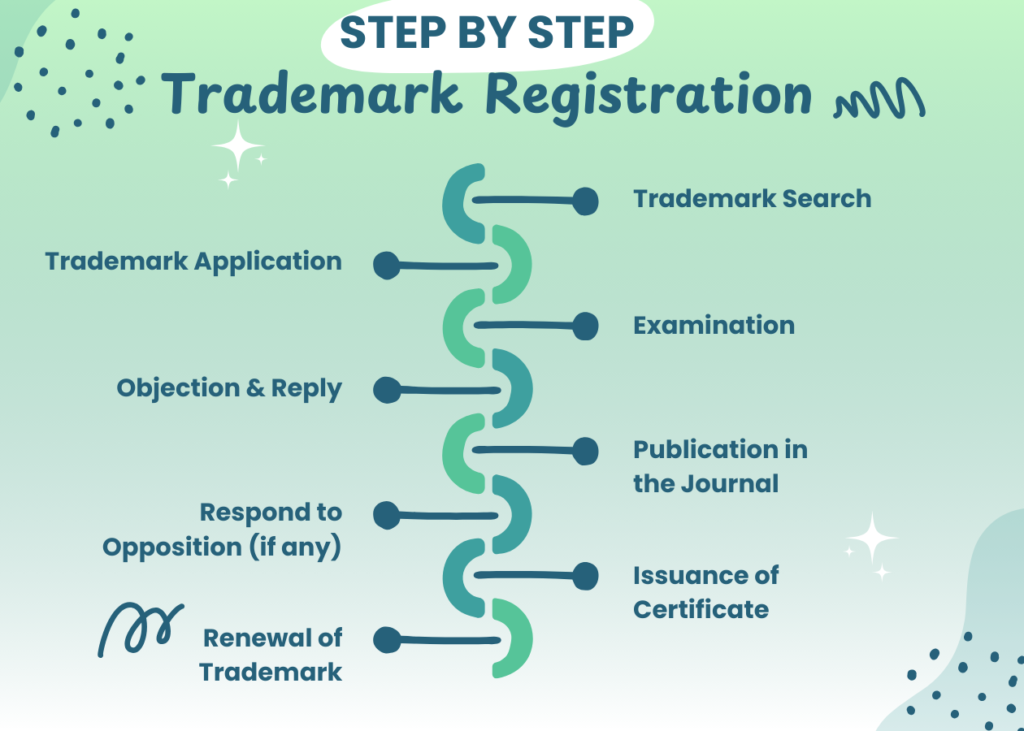
The registration process in Pakistan is governed by the Trade Marks Ordinance 2001 and the Trade Marks Rules 2004. While the Intellectual Property Organisation (IPO-Pakistan) has introduced online filing systems (as of 2023), physical filing remains an option. The process is rigorous, and the estimated time for a smooth registration is approximately 18 to 24 months.
1. The Search (Recommended but not mandatory)
Before filing, a clearance search is highly advisable to identify conflicting marks. Applicants can file a formal search request using Form TM-55. The official fee for a single search in one class is 1,000 PKR (plus two representations of the mark). Alternatively, a personal on-site search at the IPO is available for 300 PKR for 15 minutes.
2. Filing the Application
To secure a filing date, an applicant must submit specific documentation. A critical distinction in Pakistan is that you must state the basis of the application: whether the mark is “proposed to be used” or is “already in use” (including the date of first use).
| Requirement | Description |
|---|---|
| Application Form | Form TM-1 (Single class application only). |
| Applicant Details | Full name, address, nationality, and nature of business (e.g., Manufacturer/Merchant). |
| Representation | A clear JPEG image of the trademark. |
| Goods/Services | Classification according to the Nice Classification (10th Edition). |
| Power of Attorney | Signed and notarized (legalization recommended but not mandatory). Can be filed later. |
| Priority Document | If claiming priority under the Paris Convention, a certified copy must be filed within 3 months. |
Official Fees: The official government fee for filing an application is approximately 12,000 PKR per class, though some sources quote a base fee of 3,000 PKR depending on the nature of the applicant.
3. Examination and Publication
Once filed, the application undergoes formal examination (1-2 months) followed by substantive examination (6-12 months). The Registrar examines based on “Absolute Grounds” (distinctiveness) and “Relative Grounds” (conflicts with prior registrations).
If accepted, the trademark is published in the Trademarks Journal. Third parties have a 2-month window to file an opposition.
4. Registration and Renewal
If unopposed, the Registrar issues a demand note for the registration fee. Upon payment, the certificate is issued, and the trademark is considered registered retroactively from the filing date. A registration is valid for 10 years and can be renewed indefinitely in 10-year increments.
Enforcement and Anti-Counterfeiting
Pakistan has established specialized Intellectual Property Tribunals to handle infringement cases, moving jurisdiction away from general district courts to expedite IP matters.
However, registration alone is not the end of the story. Pakistan requires active use of the trademark. If a registered trademark is not used in Pakistan for a continuous period of five years from the date of registration, it becomes vulnerable to cancellation for non-use.
Available Remedies
Brand owners have several tools at their disposal to combat counterfeiting:
- Civil Action: A suit for infringement or passing off.
- Criminal Action: Under the Pakistan Penal Code (Section 482), the use of a false trademark can result in imprisonment for up to one year, a fine, or both.
- Border Measures: Rights holders can notify the Collector of Customs to treat infringing goods as prohibited. Customs has the authority to seize and destroy counterfeit imports under SRO 170(1)/2017.
Defenses and Strategies
A unique aspect of Pakistani law is the recognition of “Prior Use.” Even without registration, a party can claim rights under the common law tort of “passing off” if they can prove goodwill, misrepresentation, and damage.
Practice Note: For rights holders, the “warning notice” strategy is effective. Issuing a public notice in a newspaper (warning against imitation) or sending a legal notice to an infringer is often the first step before seeking a civil remedy. In urgent cases, courts can grant an interlocutory injunction to stop infringing activity immediately.
Conclusion
Trademark registration in Pakistan is a nuanced process that requires strategic planning. While the country’s accession to the Madrid Protocol has simplified international filings, the domestic requirement for single-class applications and the evidentiary burden for non-use necessitate working with a local attorney. For businesses looking to secure their brand equity in Pakistan, proactive registration and diligent monitoring against counterfeiting are not just legal formalities—they are essential business investments
